
Metal Powder Management Systems: Evaluating Containment and Batch Traceability

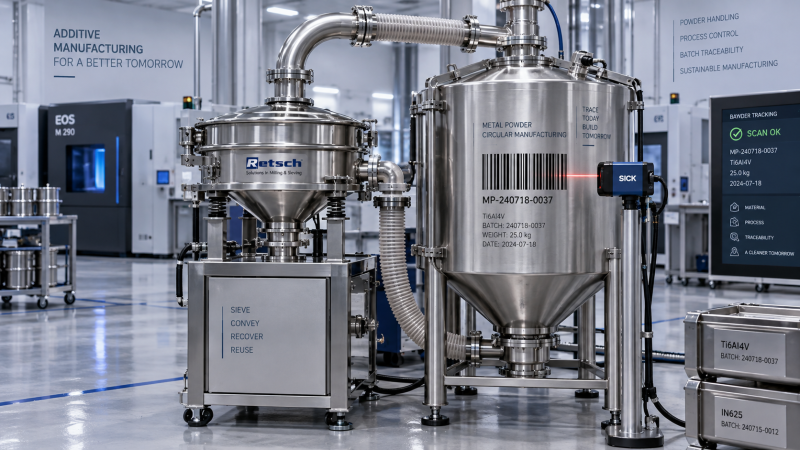
A powder container disconnects after a transfer cycle. The display reports success, but a faint residue remains around the coupling. Elsewhere, reclaimed material has passed through the sieve and returned to storage, yet its digital record identifies only the original supplier lot—not the builds, blends, or handling events that followed.
These are the gaps that make metal powder management systems difficult to evaluate from specifications alone. Enclosed equipment is not necessarily effective containment, and a barcode is not necessarily batch traceability. For technical evaluators, the real question is whether the system maintains control across the entire material journey, including the moments when operators intervene.
A credible assessment therefore connects three things: physical containment, material genealogy, and the evidence needed to verify both under production conditions.
Define the powder journey before comparing equipment
Begin with a process map rather than a supplier feature list. Follow incoming powder through receipt, sampling, storage, machine loading, recovery, sieving, blending, and reuse. Include rejected material, retained samples, cleaning residues, and waste. Every change of container or operating state creates a possible exposure point or break in identity.
The required system boundary varies. A facility using one alloy on a dedicated printer has different contamination risks from a development laboratory switching frequently between nickel, titanium, and aluminum alloys. Likewise, an automated central powder station may reduce manual handling while introducing longer transfer routes, more shared surfaces, and dependence on control-system availability.
Record the following before issuing a request for quotation:
- Alloys, particle-size distributions, and relevant powder hazards.
- Expected throughput, container sizes, and simultaneous machine demand.
- Approved reuse and blending rules for each material and application.
- Permitted exposure limits and environmental conditions.
- Cleaning, maintenance, and alloy-changeover frequency.
- Interfaces with printers, laboratory systems, and manufacturing records.
This baseline prevents an attractive demonstration from answering the wrong question. A system optimized for rapid single-alloy transfers may be unsuitable for a facility where segregation and documented changeovers dominate operating time.
Containment is a performance claim, not an enclosure description
“Closed-loop,” “sealed,” and “dust-free” are useful starting descriptions, but none establishes actual containment performance. Ask the supplier to explain what happens at each interface, particularly container docking, hose disconnection, sieve opening, filter replacement, and removal of oversize material.
The strongest evidence covers normal operation, predictable interventions, and credible faults. A clean transfer demonstration does not establish how the system behaves with a damaged seal, blocked filter, interrupted power supply, or partially filled receiving container.
Separate operator protection from powder protection
Containment must address both the environment outside the equipment and conditions inside it. Extraction or negative pressure can help control airborne release, while certain powders require controlled atmospheres to limit oxidation or moisture uptake. These objectives are related but not interchangeable.
Where inert gas is used, evaluate oxygen monitoring, sensor placement, purge verification, leakage, and the response to excursions. Also assess room ventilation and oxygen-deficiency hazards. An inert atmosphere does not automatically eliminate combustible-dust risk, and its presence introduces its own personnel-safety requirements.
For extraction and filtration, require a documented explanation of suitability for the actual powder. Conductive hoses, bonding, grounding, collection equipment, and explosion-protection measures should follow the applicable hazard assessment—not assumptions borrowed from general-purpose dust handling. Maintenance procedures must preserve these protections.
Demand representative containment testing
Ask for task-based exposure measurements supported by area monitoring where appropriate. Reports should identify the powder tested, operating sequence, sampling locations, measurement methods, detection limits, background conditions, and number of repetitions. Results obtained with one material or operating condition may not transfer directly to another.
Evaluate measurements against applicable occupational exposure limits and site requirements. Where multiple constituents matter, such as in alloy powders, the assessment should address relevant constituents rather than treating total dust mass as the only concern.
Visible cleanliness remains useful, but it is not a substitute for measurement. Fine airborne particles may escape without leaving an obvious deposit. Conversely, surface residue can reveal weak disconnection or housekeeping practices even when a short sampling exercise produces acceptable results.
Follow the batch through splits, merges, and reuse
Traceability becomes demanding when powder stops moving as a single, untouched supplier lot. A container may feed several builds. Recovered powder may be combined with unused material, screened, sampled, and blended with virgin powder. The system must retain these relationships without pretending that the resulting batch has only one parent.
A useful conceptual map shows supplier lots feeding containers, containers feeding builds, and recovered material becoming new controlled batches through processing and release.
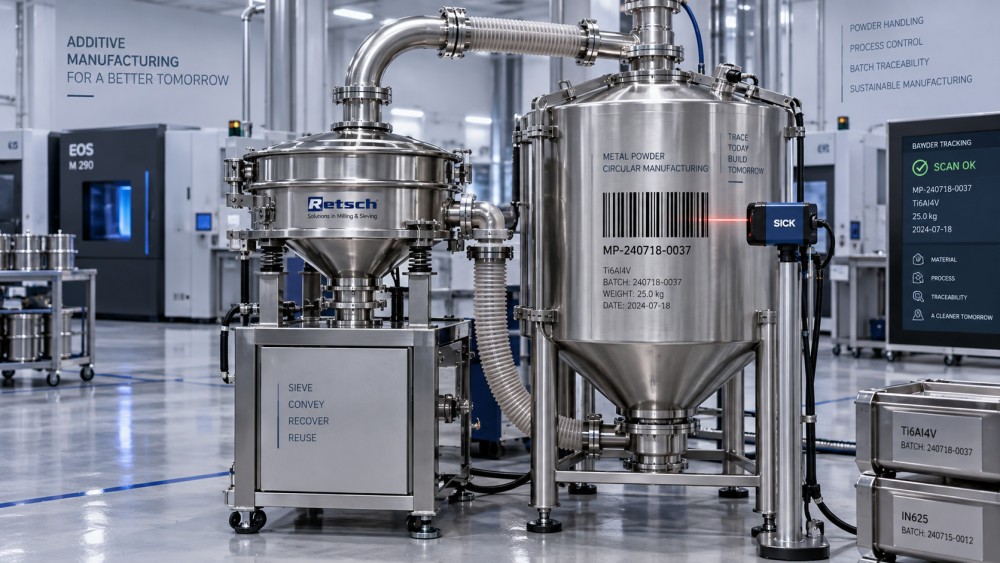
Require the supplier to demonstrate this genealogy using a realistic split-and-merge sequence. For example, an evaluator can create two test lots, divide one between containers, blend selected portions, process the blend, and then request the history of material assigned to a build. This is a test scenario, not a claim about any particular installation.
The resulting record should preserve:
- Supplier lot identifiers and receiving documentation.
- Unique identities for containers and internally created batches.
- Recorded quantities, units, and measurement sources.
- Parent–child relationships for splits and merges.
- Relevant build exposure, recovery, sieving, and blending events.
- Sampling results, release decisions, and quarantine status.
- Operator or automated-system identity, timestamps, and equipment identity.
Distinguish between a material batch and its container. Containers can be emptied, cleaned, and reused; material identity must not silently follow the physical vessel into its next assignment. Likewise, a printed label should not override a quarantine state merely because the scanner recognizes it.
Mass balance should expose uncertainty
Compare received, transferred, recovered, rejected, sampled, disposed, and remaining quantities. Allowances may be needed for retained powder, measurement uncertainty, and process losses, but those allowances should be defined and justified.
A system that forces every transaction to balance perfectly can conceal rather than resolve discrepancies. Ask whether unexplained differences trigger review, whether quantities can be corrected, and whether corrections preserve the original entry and authorization history.
Reuse counts also need careful interpretation. “Reused three times” is ambiguous when batches contain material with different histories. Genealogy can document those histories, but it cannot identify the exposure history of every individual particle in a mixture. Release decisions must combine records with appropriate material testing.
Traceability does not prove powder suitability
A complete history tells evaluators what happened to a batch. It does not, by itself, prove that the batch remains suitable for a demanding application.
Relevant checks may include particle-size distribution, flow behavior, apparent density, morphology, moisture, and chemical composition, including oxygen or other interstitial elements where material-specific requirements warrant them. Sampling and test methods should match the alloy, process, and acceptance specification. ASTM and ISO methods can support consistent measurement, but there is no universal test package or reuse limit for every metal powder.
Look closely at the link between laboratory results and production authorization. Can the system stop an unreleased batch from being loaded? What happens if a result is revised after material has already been consumed? Can affected builds be identified promptly?
Cross-contamination deserves a separate assessment. Shared sieves, transfer lines, valves, and sampling tools can retain material in inaccessible locations. A cleaning declaration is weaker evidence than a validated changeover procedure supported by inspection or analytical checks appropriate to the contamination risk.
For incompatible or tightly controlled materials, dedicated contact components may be more defensible than repeated cleaning. The decision should reflect acceptable contamination thresholds, cleaning accessibility, verification capability, and production economics—not convenience alone.
Challenge the software where production becomes untidy
Digital traceability often looks convincing during a scripted presentation. Its reliability becomes clearer when the sequence changes.
During evaluation, interrupt a transfer, disconnect the network, scan the wrong container, attempt to load quarantined material, and introduce a quantity discrepancy. Establish how transactions are reconciled after recovery and whether the system prevents duplicate, missing, or out-of-sequence records.
Audit trails should make consequential changes attributable and reviewable. Examine user permissions, timestamp synchronization, retention, backups, and restoration testing. Ask whether administrators can alter material status or records without leaving an appropriate history.
Integration also needs more than an “API available” statement. Define which platform owns each identifier and status, how units are handled, and what happens when systems disagree. A printer, powder station, and manufacturing execution system may each maintain a different view of the same batch unless ownership rules are explicit.
Data portability is a procurement requirement. Request sample exports that retain genealogy, test-result references, transactions, and audit information. Flat inventory reports may be insufficient for an investigation, particularly if reconstructing relationships depends on continued access to proprietary software.
Turn acceptance testing into a purchasing decision
Build a test plan before selecting the preferred supplier. For metal powder management systems, factory acceptance testing should challenge transfer sequences, identity controls, interlocks, and data handling. Site acceptance testing should confirm performance with installed utilities, actual interfaces, representative materials, and local operating procedures.
Acceptance criteria should be agreed in advance. Useful measures include task-specific exposure performance, transfer repeatability, material recovery, unexplained mass discrepancies, successful genealogy retrieval, and demonstrated blocking of unauthorized material. Thresholds should come from the facility’s hazard assessment and process requirements, not arbitrary industry-wide targets.
Score safety and traceability as eligibility gates before comparing throughput or price. A weighted score can otherwise allow fast transfers to compensate mathematically for an unacceptable containment weakness.
For systems that pass those gates, compare total operating burden: consumables, cleaning time, atmosphere-control costs, calibration, software support, spare parts, waste handling, and downtime. Request throughput evidence for the intended powder and transfer route; nominal capacity may exclude docking, purging, sampling, and changeover time.
Choose the system that can explain exceptions
Within G-AIT’s multidisciplinary benchmarking approach, powder management belongs at the intersection of additive manufacturing, material characterization, industrial controls, and safety engineering. Technical specifications matter, but procurement confidence comes from connecting those specifications to verifiable operating evidence.
The decisive question is not simply whether a system transfers powder without visible dust. It is whether the facility can demonstrate controlled handling, defend a batch’s history, and identify affected material when something goes wrong.
A defensible selection combines measured containment, explicit material-release rules, durable genealogy, and tested integration. When those foundations are established, automation becomes genuinely valuable: it reduces handling effort without making the material journey harder to understand.
Related News
How to verify part consistency before choosing a 3D printing OEM
Choosing a 3D printing OEM? Learn how to verify part consistency with repeat-build trials, validated inspections, and traceability checks before committing to production.
How does a rigid cryogenic transfer line handle thermal contraction?
Learn how a rigid cryogenic transfer line manages thermal contraction with bends, bellows, and guided supports. Discover key design checks for safe, reliable cryogenic performance.

How much does edge vision deployment cost beyond the hardware?
Understand edge vision deployment cost beyond hardware, from data and integration to security and support. Uncover hidden expenses and build a smarter lifecycle budget before you scale.

How does the purity of sputtering targets affect thin-film quality?
Discover how sputtering targets affect thin-film quality. Learn to assess purity, identify harmful impurities, and choose specifications that improve coating performance.
How high power laser cladding systems control substrate dilution
Discover how high power laser cladding systems control substrate dilution through beam shaping, material feed, and thermal management to deliver reliable bonds and coating performance.
How to check HS codes for customs compliance in international logistics
Strengthen international logistics customs compliance: learn how to verify HS codes, check official tariffs, and document classifications to reduce costly shipment delays.
Choosing a 3D Printing Service for Consumer Products: Finish, Fit, and Cost
Compare 3d printing consumer good services by finish, fit, materials, and total cost. Learn how to choose a reliable supplier and avoid costly defects before ordering.
Which Consumer Goods Can Be 3D Printed, and What Are the Practical Limits?
Explore 3d printing consumer goods, from custom eyewear to replacement parts. Discover practical limits on materials, safety, and costs to make smarter production decisions.
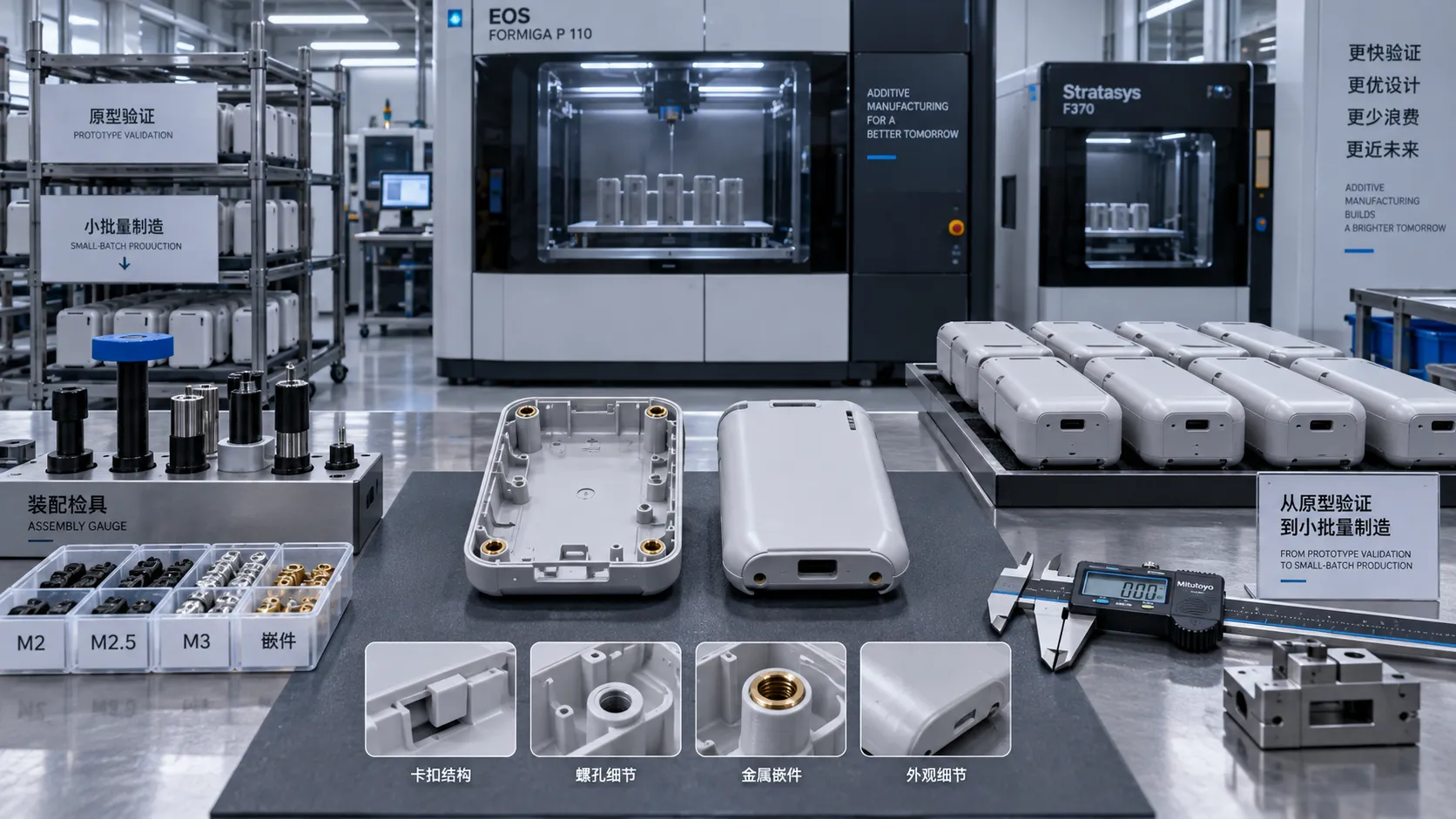
From Prototype to Small Batch: Applying 3D Printing to Consumer Goods
Explore 3d printing in consumer goods: learn how to move from prototype to small-batch production with practical guidance on materials, quality validation, and cost control.
Related News
- 00
0000-00
How to verify part consistency before choosing a 3D printing OEM - 00
0000-00
How does a rigid cryogenic transfer line handle thermal contraction? - 00
0000-00
How much does edge vision deployment cost beyond the hardware? - 00
0000-00
How does the purity of sputtering targets affect thin-film quality? - 00
0000-00
How high power laser cladding systems control substrate dilution
Marcus Print
Weekly Insights
Stay ahead with our curated technology reports delivered every Monday.