
Business intelligence news signals that may change investment timing


Business intelligence news can shift investment timing faster than quarterly reports, especially when export controls, patent activity, and procurement trends move across advanced manufacturing sectors. For financial approvers, this article highlights how verified technical benchmarks and market signals from lasers, additive manufacturing, machine vision, nano-materials, and vacuum engineering can reduce decision risk and improve capital allocation.
Why scenario differences matter more than headline speed
For financial approvers, the value of business intelligence news is not simply that it arrives early. Its value depends on whether a signal affects a live capex plan, a supplier qualification cycle, or a compliance-sensitive sourcing decision. In advanced industrial markets, a single policy change can alter lead times by 8 to 24 weeks, reshape approved vendor lists, or delay factory acceptance tests tied to ISO, ASTM, SEMI, or IEEE-related requirements.
This is why scenario-based interpretation matters. A procurement team buying a multi-kilowatt laser source for near-term production has a different timing problem than an R&D center evaluating a metal additive platform for 18-month development goals. The same business intelligence news item may trigger immediate action in one case and a watchlist review in another. Timing quality comes from matching the signal to the operational stage, not from reacting to noise.
G-AIT’s role is especially relevant in this context because financial approval rarely depends on one variable. Decision quality improves when technical benchmarks, export-control alerts, patent movement, and tender activity are assessed together across five industrial pillars: Industrial Laser Processing, 3D Printing & Additive Manufacturing, Machine Vision & Optical Inspection, High-Performance Graphene & Nano-materials, and Vacuum & Cryogenic Engineering.
How financial approvers usually experience timing risk
In practice, timing risk appears in three forms. First, capital may be released too early, before technical stability or supply continuity is visible. Second, capital may be released too late, after competitor procurement cycles have tightened component availability. Third, approvals may be based on surface-level market commentary rather than verified benchmarks, creating hidden cost overruns during installation, validation, or regulatory review.
- Immediate-action scenario: policy, export, or sourcing changes that can affect contracts within 30 to 90 days.
- Mid-cycle scenario: technical and supplier signals that influence budgeting and vendor ranking over 1 to 2 quarters.
- Strategic scenario: patent concentration, standards direction, and application maturity shaping 12- to 36-month allocation plans.
When business intelligence news is interpreted through these three windows, it becomes more than media consumption. It becomes an approval tool for deciding whether to accelerate, stage, defer, or split investment.
Three common investment scenarios where business intelligence news changes timing
Different industrial programs react to different signal types. The table below compares three common scenarios seen by financial approvers in high-tech manufacturing and engineering procurement. It shows why the same business intelligence news may justify opposite timing decisions depending on the project stage and operational exposure.
The practical insight is that financial approval should follow the scenario logic, not the excitement level of the news cycle. For example, supplier backlog data may matter more than a breakthrough headline if your asset must be installed within the next 2 quarters. Conversely, a rising patent cluster in nano-materials may deserve more weight than near-term pricing if your goal is long-horizon platform positioning.
Scenario 1: Production-line upgrades under time pressure
In laser processing, machine vision, and vacuum engineering, investment timing often depends on whether operational disruption can be avoided during a planned shutdown window. If business intelligence news indicates tighter component export review, slower chamber delivery, or increasing demand for inspection systems, the cost of waiting may exceed the benefit of price negotiation. A delay of 10 to 16 weeks can push installation into the next maintenance cycle.
In this scenario, financial approvers should look beyond the purchase price. The real question is whether the approved budget preserves throughput, yield stability, and contractual delivery commitments. Verified technical benchmarking matters because it helps distinguish between systems that are merely available and systems that can pass integration, calibration, and acceptance requirements with limited rework.
What to prioritize
- Lead time by subsystem, not just headline equipment lead time.
- Availability of test data aligned with intended materials, tolerances, or vacuum levels.
- Service response windows, spare-part readiness, and installation sequencing.
Here, business intelligence news is most useful when it confirms whether a procurement window is tightening. Fast action may be justified if the technical pathway is already known and the key uncertainty is supply continuity.
Scenario 2: R&D capacity building for emerging applications
For additive manufacturing platforms, graphene-related material evaluation, or AI-enabled optical inspection, the timing logic is different. These investments often support product development cycles of 12 to 36 months, where the main risk is not immediate downtime but strategic misalignment. In this setting, business intelligence news about patents, standards alignment, and application validation can help decide whether to fund a pilot, expand capability, or wait for benchmark maturity.
Financial approvers should ask whether the new platform has enough interoperability and test evidence to support future development branches. A lower-cost system may look attractive at budget review stage, yet create hidden costs if material parameters, scan strategies, optical resolution, or process atmosphere controls are not transferable to later production-grade tools.
In this scenario, staged approval often works better than full release. A common structure is pilot validation in 3 to 6 months, data review after the first materials or process campaign, and expansion only if repeatability and compliance pathways look credible.
Scenario 3: Compliance-driven supplier shifts
A third scenario appears when procurement teams need alternate sourcing due to export restrictions, tender conditions, localization policy, or customer audit requirements. This is common in vacuum components, optical inspection hardware, and specialty materials where performance depends on exact process conditions. Business intelligence news becomes a trigger for qualification planning, not just contract timing.
For financial approvers, the danger is assuming supplier substitution is a simple price event. In reality, a replacement source may require 2 to 4 validation cycles, fresh documentation review, revised maintenance assumptions, or modified software compatibility checks. The timing decision should therefore include qualification cost and schedule, not merely the new unit price.
If technical benchmarking shows clear equivalence under recognized standards and operating ranges, earlier approval may reduce future disruption. If equivalence remains uncertain, a deferred or split investment can protect capital while preserving optionality.
How sector-specific signals should be read across five industrial pillars
Not all business intelligence news has the same meaning across industrial sectors. A patent spike in additive manufacturing does not carry the same timing weight as an export update affecting laser subsystems. Financial approvers benefit when signals are interpreted according to the operating economics and validation burdens of each technology class.
Industrial Laser Processing
In laser processing, timing is often sensitive to source availability, beam delivery components, cooling integration, and application-specific cut or weld quality. Business intelligence news matters most when it points to changes in subsystem supply, industrial demand concentration, or technical upgrades that improve throughput or reduce scrap within measurable ranges such as 5% to 15% in process efficiency under stable conditions.
Financial review should compare whether a new system changes payback because of uptime and consumable performance, not only because of purchase cost. If benchmark data indicates better repeatability under your material thickness range, faster timing may be justified.
3D Printing & Additive Manufacturing
Here, business intelligence news often revolves around material qualification, build volume expansion, software workflow integration, and certification pathways. Timing should be linked to whether your organization is prototyping, toolmaking, low-volume production, or qualification for regulated sectors. A platform suitable for concept iteration may not be sufficient for repeatable production documentation six months later.
Approvals should consider powder or feedstock consistency, process monitoring maturity, and post-processing requirements. These factors heavily influence whether capital should be released in one phase or two.
Machine Vision & Optical Inspection
In machine vision, signal value often comes from improvements in inspection speed, false-reject control, AI integration, and compatibility with existing MES or quality systems. For high-volume lines, even a small shift in false-positive rates can change the economics of investment timing. News about sensor supply or software compliance may matter more than broad automation sentiment.
Financial approvers should check whether benchmark claims reflect real production conditions, such as lighting variability, surface reflectivity, and inspection cycle time limits. Timing should follow proven deployment suitability, not feature count.
Graphene, nano-materials, vacuum, and cryogenic engineering
For graphene and nano-materials, business intelligence news about patent clustering, process reproducibility, and downstream application pull is often more important than short-term pricing. In vacuum and cryogenic systems, however, component compatibility, seal integrity, pressure range, contamination control, and delivery sequence can directly reshape project timing.
A vacuum chamber or cryogenic subsystem may require long fabrication and verification cycles, sometimes extending beyond 20 weeks depending on complexity. Financial timing should therefore incorporate technical review checkpoints earlier than in less specialized procurement categories.
A practical decision matrix for financial approvers
The next table translates business intelligence news into approval actions. It is designed for organizations balancing technical risk, budget discipline, and project urgency across complex industrial programs.
A useful rule is to match signal strength with commitment size. Weak or early-stage signals may justify deeper diligence, while strong signals supported by technical benchmarks and compliance implications may justify faster approval. This reduces the chance of freezing capital too soon or missing a narrowing procurement window.
A four-step review path
- Define the scenario: immediate production need, capability expansion, or supplier substitution.
- Test the signal: verify whether the business intelligence news is supported by benchmark, tender, or compliance data.
- Estimate the timing impact: compare 30-day, 90-day, and 2-quarter outcomes.
- Choose the approval model: full release, phased release, pilot first, or defer pending validation.
This approach helps finance teams move from generic market awareness to investment discipline grounded in application reality.
Common misreads that lead to poor investment timing
The most common mistake is treating all business intelligence news as urgency. In reality, some signals are operational, some are strategic, and some are only directional. Approving capital on the basis of broad excitement can create stranded capacity or underused systems, especially in specialized industrial environments where qualification and integration take longer than purchase approval.
Another frequent error is separating technical review from financial timing. If engineering evidence arrives after budget release, finance may approve an asset whose real fit remains unproven. That mismatch often appears in additive manufacturing, optical inspection, and vacuum systems, where application conditions determine the value more than the headline specification sheet.
Red flags to check before accelerating approval
- Lead-time claims are given only for the main machine, while critical subsystems are excluded.
- Benchmark data is generic and not tied to your process range, material set, or inspection threshold.
- The proposed supplier path lacks clarity on standards alignment, documentation, or acceptance testing.
- Patent or market activity is interpreted as immediate purchase pressure without application relevance.
These checks are especially important when procurement teams feel pressure to react quickly. Business intelligence news should improve timing discipline, not replace it.
Where caution is usually justified
Caution is usually appropriate when the technical stack is new to the organization, when compliance implications are still being interpreted, or when qualification must be repeated across multiple sites. In such cases, a phased commercial structure often protects both schedule and cash flow more effectively than a single all-in commitment.
By contrast, faster approval can be rational when the use case is known, the vendor path is validated, and the business intelligence news clearly indicates a tightening external condition such as constrained delivery or a narrowing sourcing window.
Why choose us for scenario-based industrial intelligence
G-AIT supports financial approvers who need more than market headlines. We connect business intelligence news with verified engineering context across industrial lasers, additive manufacturing, machine vision, graphene and nano-materials, and vacuum and cryogenic engineering. That means your team can assess not only whether a signal is important, but also whether it matters for your exact investment scenario.
Our multidisciplinary approach is built for high-stakes B2B decisions where procurement timing, technical reliability, and compliance exposure intersect. Instead of relying on isolated commentary, you can review benchmark-oriented intelligence that reflects real purchasing conditions, common validation checkpoints, and standards-aware decision factors relevant to global supply chains.
If you are evaluating whether to accelerate, defer, or stage an industrial investment, contact us for scenario-specific support. We can help you confirm technical parameters, compare solution paths, review likely delivery windows, assess customization implications, discuss applicable certification or standards expectations, and structure supplier or quotation discussions around real project risk. This is especially useful when business intelligence news suggests a market shift, but the right timing still depends on your application, approval threshold, and deployment plan.
Related News

How to verify part consistency before choosing a 3D printing OEM
Choosing a 3D printing OEM? Learn how to verify part consistency with repeat-build trials, validated inspections, and traceability checks before committing to production.

How does a rigid cryogenic transfer line handle thermal contraction?
Learn how a rigid cryogenic transfer line manages thermal contraction with bends, bellows, and guided supports. Discover key design checks for safe, reliable cryogenic performance.

How much does edge vision deployment cost beyond the hardware?
Understand edge vision deployment cost beyond hardware, from data and integration to security and support. Uncover hidden expenses and build a smarter lifecycle budget before you scale.

How does the purity of sputtering targets affect thin-film quality?
Discover how sputtering targets affect thin-film quality. Learn to assess purity, identify harmful impurities, and choose specifications that improve coating performance.

How high power laser cladding systems control substrate dilution
Discover how high power laser cladding systems control substrate dilution through beam shaping, material feed, and thermal management to deliver reliable bonds and coating performance.

How to check HS codes for customs compliance in international logistics
Strengthen international logistics customs compliance: learn how to verify HS codes, check official tariffs, and document classifications to reduce costly shipment delays.
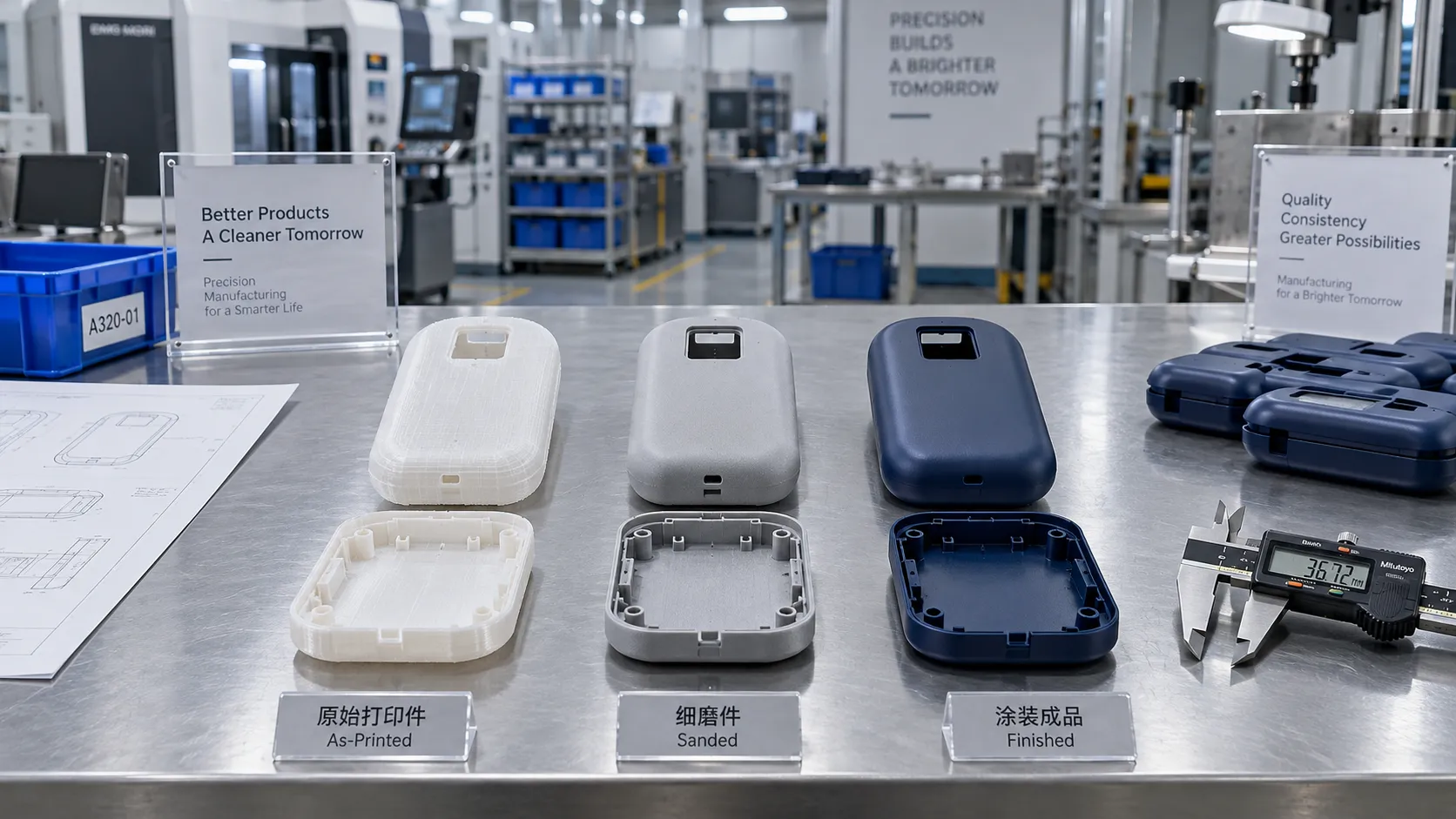
Choosing a 3D Printing Service for Consumer Products: Finish, Fit, and Cost
Compare 3d printing consumer good services by finish, fit, materials, and total cost. Learn how to choose a reliable supplier and avoid costly defects before ordering.

Which Consumer Goods Can Be 3D Printed, and What Are the Practical Limits?
Explore 3d printing consumer goods, from custom eyewear to replacement parts. Discover practical limits on materials, safety, and costs to make smarter production decisions.

From Prototype to Small Batch: Applying 3D Printing to Consumer Goods
Explore 3d printing in consumer goods: learn how to move from prototype to small-batch production with practical guidance on materials, quality validation, and cost control.
Related News
- 00
0000-00
How to verify part consistency before choosing a 3D printing OEM - 00
0000-00
How does a rigid cryogenic transfer line handle thermal contraction? - 00
0000-00
How much does edge vision deployment cost beyond the hardware? - 00
0000-00
How does the purity of sputtering targets affect thin-film quality? - 00
0000-00
How high power laser cladding systems control substrate dilution
Dr. Victor Gear
Weekly Insights
Stay ahead with our curated technology reports delivered every Monday.