
3D Printing for Dental Applications: Accuracy Problems to Watch

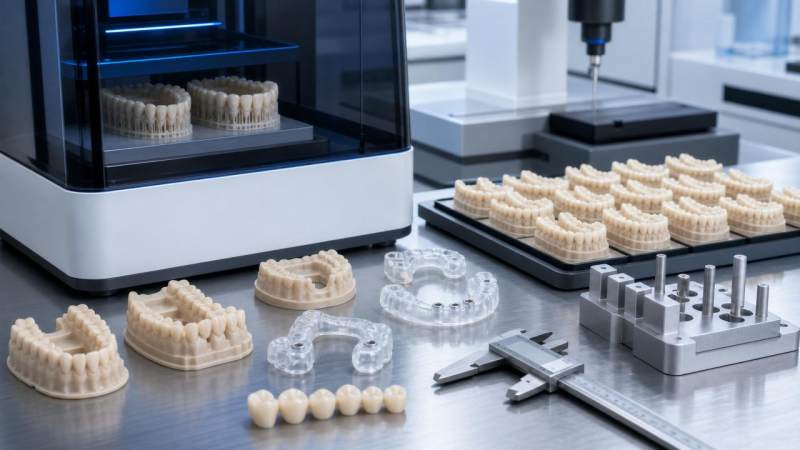
In 3D printing for dental applications, accuracy is more than a quality metric—it directly affects fit, function, patient safety, and regulatory compliance. For quality control and safety managers, even minor deviations in print resolution, shrinkage, or post-processing can lead to costly failures. This article highlights the key accuracy problems to watch and how to evaluate them within a reliable manufacturing framework.
Across dental labs, device manufacturers, and outsourced additive production networks, the pressure is increasing to deliver repeatable parts within tight tolerance windows, often in batches of 10, 50, or 200 units with minimal rework. Whether the output is a surgical guide, aligner model, denture base, temporary crown, or castable pattern, the acceptable error is usually measured in tenths or hundredths of a millimeter. For quality and safety teams, 3D printing for dental applications must therefore be assessed as a controlled production process, not just a fast prototyping tool.
This is especially relevant in B2B purchasing and supplier qualification. A machine that prints visually acceptable parts may still fail under dimensional inspection, sterilization exposure, biocompatibility review, or batch consistency checks over 3 to 6 months of operation. For organizations benchmarking suppliers or internal production cells, the challenge is to identify which accuracy problems create the highest downstream risk and which controls can reduce defect rates before products reach clinical use.
Why Accuracy in Dental 3D Printing Demands Tighter Quality Control
Dental parts are small, geometry-sensitive, and functionally unforgiving. In many workflows, a deviation of ±0.10 mm may already compromise contact surfaces, insertion fit, occlusion, or seating stability. For surgical guides and restorative components, even smaller shifts can affect drill path guidance or margin integrity. That is why 3D printing for dental applications requires a stricter quality framework than many general industrial polymer jobs.
The Cost of Minor Dimensional Drift
A recurring problem in dental additive manufacturing is that small errors accumulate across several stages. A printer may introduce 40 to 80 microns of dimensional variation, the resin may shrink another 0.5% to 1.5% during curing, and post-processing may add distortion if support removal is uneven. Each deviation may look manageable alone, but combined they can push the final part outside the acceptable range.
For quality managers, this means that first-pass acceptance should not be judged only by visual appearance. A smooth surface can hide warp, unsupported edge lift, or internal feature inaccuracy. Safety managers should also consider indirect risk: a poorly fitted guide or tray can trigger chairside adjustments, repeated sterilization cycles, delayed procedures, and increased traceability burden.
Where Tolerance Expectations Are Usually Tightest
Not all dental outputs face the same tolerance requirement. Model printing may allow a broader functional window than implant-related guides or precision-fit splints. Procurement teams should therefore ask suppliers to specify target tolerance by application category, build orientation, material family, and post-cure method rather than quoting one generic accuracy number for all jobs.
- Diagnostic models: often evaluated in the ±0.10 mm to ±0.20 mm range depending on use case
- Surgical guides: commonly require tighter control, often closer to ±0.05 mm to ±0.10 mm in critical zones
- Temporary restorations and splints: fit-sensitive areas may require sub-0.10 mm consistency
- Castable patterns and denture bases: geometry stability through printing and curing becomes the key control point
The table below outlines how common dental product categories differ in their typical accuracy concerns and quality review priorities.
The main takeaway is that quality criteria should be application-specific. A supplier claiming “high precision” without identifying the feature type, tolerance zone, and verification method is not providing decision-grade information for 3D printing for dental applications.
The Most Common Accuracy Problems to Watch
In practical production, accuracy failures usually fall into 5 to 7 recurring categories. These are not limited to printer hardware. They span digital file preparation, material behavior, environmental control, operator consistency, and inspection capability. Quality and safety leaders should map the full chain instead of isolating root cause to the machine alone.
1. Print Resolution Does Not Equal Dimensional Accuracy
Many buyers focus on XY pixel size or layer thickness, such as 35, 50, or 100 microns. These parameters matter, but they do not automatically guarantee final accuracy. A printer may offer fine layers while still producing scale deviation, edge rounding, or feature shift due to optics calibration, peeling forces, or inadequate compensation settings.
For dental workflows, the more relevant question is whether the full system can repeatedly reproduce critical dimensions over at least 3 consecutive builds. Quality teams should request data on internal versus external feature error, not just nominal resolution claims.
2. Resin Shrinkage and Cure Distortion
Photopolymer shrinkage remains one of the most important hidden variables in 3D printing for dental applications. Depending on resin chemistry, part geometry, wall thickness, and post-cure energy, dimensional change can occur during printing, washing, post-curing, and even within 24 hours after processing. Thin sections may bend, while thicker sections may pull inward or outward unevenly.
This is especially critical when a supplier changes resin lot, curing time, or chamber temperature without revalidation. A 10-minute difference in cure cycle or a 5°C shift in ambient conditions may appear minor but can change final part dimensions enough to affect fit-sensitive devices.
3. Build Orientation and Support Strategy Errors
Orientation can strongly influence warpage, support scar location, and surface fidelity on critical interfaces. A model printed flat for speed may develop peel-related stress, while a steep orientation may reduce large-area deformation but increase support contact points. Neither option is universally correct.
From a quality perspective, orientation should be standardized by application. If one operator prints a guide at 30 degrees and another at 60 degrees, the output may differ enough to create inspection variability. Safety managers should ensure that validated work instructions define acceptable orientation windows, support density ranges, and support removal rules.
4. Scanner-to-Printer Data Chain Inconsistency
Accuracy loss often begins before printing. Intraoral or lab scanning errors, mesh smoothing, STL export compression, and CAD compensation steps can all introduce geometry drift. If the source model is already biased by 50 to 100 microns, even a highly capable printer cannot recover the lost truth.
For this reason, 3D printing for dental applications should be reviewed as a digital manufacturing chain. Incoming scan validation, file version control, and design freeze approval are basic but essential controls. Without them, inspection teams may reject printed parts for errors that actually originated upstream.
5. Post-Processing Variation
Washing, drying, support removal, UV post-curing, and final finishing can alter dimensions more than many teams expect. Excessive solvent exposure may soften edges; aggressive support removal may chip or flex thin geometry; uneven UV exposure may create localized over-cure. In some facilities, post-processing causes more dimensional drift than the printer itself.
A robust quality plan therefore needs measurable post-process settings: wash duration in minutes, solvent replacement frequency, cure cycle duration, cure chamber intensity range, and cooling or conditioning time before final inspection.
How Quality and Safety Managers Should Evaluate Accuracy Risk
A reliable evaluation framework should combine machine capability, process discipline, and evidence-based inspection. For supplier qualification or internal line release, the goal is not only to confirm that one sample fits, but to prove that the process remains stable over time, operators, and material lots.
Key Audit Questions Before Approval
Before approving a vendor or production cell, quality teams should document at least 6 checkpoints: printer calibration frequency, resin lot traceability, build orientation control, post-cure validation, inspection method, and nonconformance handling. If even 2 of these items are weak, long-term repeatability can become unpredictable.
- How often is the printer calibrated: daily, weekly, or per production batch?
- Are dimensional checks based on calipers only, or on optical scanning and 3D comparison?
- Is there a defined hold time between printing and final inspection, such as 30 minutes, 2 hours, or 24 hours?
- Are reprints tracked by cause code, with defect rates reviewed monthly?
- Are critical geometries verified on 100% of parts or through statistically defined sampling?
The following table can be used as a practical qualification matrix when reviewing 3D printing for dental applications in a B2B supply environment.
This matrix helps convert abstract “precision” claims into auditable controls. It is also useful for procurement reviews, supplier onboarding, and cross-functional discussions between engineering, quality, and safety teams.
Recommended Inspection Sequence
A practical inspection sequence usually contains 4 stages. First, confirm digital file revision and approved build parameters. Second, inspect a first-off sample immediately after printing and after post-curing to measure dimensional shift. Third, compare critical features using either optical scanning or validated contact metrology. Fourth, trend batch data over time to detect drift before a major nonconformance appears.
Where possible, use reference artifacts with known geometry and inspect them at a defined frequency, such as once per shift, once per resin refill, or every 25 builds. This approach gives quality teams an early-warning signal and supports a more preventive manufacturing model.
Environmental Conditions Matter More Than Expected
Temperature, humidity, and resin handling time can all affect viscosity, layer formation, and curing behavior. A room maintained at 20°C to 25°C with stable humidity usually performs better than a space that swings across 8°C in a day. If production is outsourced across multiple sites, environmental standardization should be part of the supply agreement, not left as an operator preference.
How to Build a More Reliable Manufacturing Framework
Reducing accuracy problems in 3D printing for dental applications requires a system approach. Hardware selection matters, but consistency comes from the combination of validated materials, documented workflows, trained operators, and closed-loop inspection. For institutions such as G-AIT that benchmark manufacturing technologies against international standards and reliability expectations, this broader framework is what separates scalable production from isolated success.
Standardize the Process Window
Each validated dental workflow should define a process window that includes layer thickness, orientation range, support strategy, wash duration, cure duration, acceptable ambient conditions, and inspection timing. If the process changes, even by one resin lot or one cure chamber, revalidation may be needed for critical applications. This is especially important for organizations serving regulated markets or multi-site production networks.
Use Application-Specific Acceptance Criteria
A one-size-fits-all acceptance rule is rarely effective. Critical-to-quality features should be defined per product type: hole position for guides, contact fit for splints, arch geometry for models, or base flatness for dentures. Acceptance criteria should include dimensional limits, visual defect thresholds, and post-process requirements, with clear pass/fail logic.
Invest in Traceability and Trending
Batch records should capture at least 8 fields: file revision, printer ID, operator, resin lot, orientation preset, wash cycle, cure cycle, and inspection outcome. Over a 90-day review period, this data can reveal recurring drift patterns that are invisible in isolated job reviews. For safety managers, traceability is not just documentation; it is a risk containment tool if field issues arise.
Common Misjudgments to Avoid
- Assuming nominal layer thickness reflects final part accuracy
- Approving a process after only 1 successful sample build
- Ignoring post-cure dimensional change during inspection planning
- Using generic resin settings across different part geometries
- Relying on operator experience instead of documented process control
For buyers and manufacturing decision-makers, the strongest suppliers are usually those that can explain not only what tolerance they target, but how they maintain it over repeated production, material changes, and inspection cycles. That level of discipline is increasingly important as dental additive manufacturing moves from lab-scale output to industrialized, quality-managed production.
Accuracy problems in 3D printing for dental applications rarely come from a single source. They emerge from the interaction of machine calibration, resin behavior, digital file integrity, orientation strategy, and post-processing control. For quality control and safety managers, the right response is to evaluate the entire process chain, define measurable acceptance criteria, and require evidence of repeatability rather than marketing-level precision claims.
If your organization is assessing suppliers, upgrading a dental additive workflow, or building a more defensible quality framework, a benchmark-driven review can reduce both technical risk and procurement uncertainty. Contact us to discuss your application, request a customized evaluation approach, or learn more about dependable solutions for advanced industrial and dental manufacturing environments.
Related News
Tier-1 Suppliers vs Others: What Matters Before You Commit
Tier-1 Suppliers vs other vendors: learn how to compare risk, compliance, delivery resilience, and total cost before you commit to the right sourcing partner.

Cross-Border E-Commerce Logistics Solutions: How to Cut Delays
Cross-border e-commerce logistics solutions that reduce delays by improving customs data, route planning, packaging, and compliance control for faster, more reliable global delivery.

Energy Industry Supply Chain Management: Key Risk Control Points
Energy industry supply chain management starts with scenario-based risk control. Learn how to reduce delays, improve compliance, and strengthen supplier resilience across energy projects.

Clean Energy Policy Updates That Could Reshape 2026 Planning
Clean energy policy updates are redefining 2026 planning, from incentives and grid rules to supplier risk and compliance. Discover the shifts that could impact investment, operations, and growth.

Carbon Footprint: 7 Cost Drivers Companies Often Miss
Carbon footprint costs are often underestimated. Discover 7 hidden drivers that raise energy, logistics, compliance, and procurement risk—and learn how smarter benchmarking protects margins.

Manufacturing Industry Market Analysis: 2026 Signals to Watch
Manufacturing industry market analysis for 2026 reveals the signals that matter most: automation, compliance, supply chain shifts, and high-value production. Discover where real growth and resilience are emerging.
Vacuum Technology for Space Exploration: Core System Choices
Vacuum technology for space exploration explained through core system choices, contamination control, pump selection, and procurement criteria to improve mission reliability and testing efficiency.

Supply Chain Risks That Quietly Raise Operating Costs
Supply chain risks often hide in quality drift, lead-time variation, compliance gaps, and weak visibility. Learn how to spot cost leaks early and protect margins with smarter sourcing.

How In-Depth Industry Reports Reveal Market Shifts Early
In-depth industry reports reveal early market shifts through verified benchmarks, regulatory tracking, and commercial signals—helping leaders spot risk, demand, and opportunity sooner.
Related News
- 00
0000-00
Tier-1 Suppliers vs Others: What Matters Before You Commit - 00
0000-00
Cross-Border E-Commerce Logistics Solutions: How to Cut Delays - 00
0000-00
Energy Industry Supply Chain Management: Key Risk Control Points - 00
0000-00
Clean Energy Policy Updates That Could Reshape 2026 Planning - 00
0000-00
Carbon Footprint: 7 Cost Drivers Companies Often Miss
Marcus Print
Weekly Insights
Stay ahead with our curated technology reports delivered every Monday.